
If you need to how to remove spark plug from lawn mower, the job is usually simple, but doing it the wrong way can damage the plug, the wire, or even the engine threads. The good news is that most mower spark plugs come out in a few minutes with basic hand tools.
This guide shows the full process step by step, from finding the plug to reinstalling it correctly. You will also see the common mistakes people make, how to tell if the plug is stuck, and when the problem needs more than a wrench.
Before you start, one safety note matters more than anything else: a mower can start unexpectedly if the spark plug wire is still attached. Always disconnect it first, and never work near the blade or belt while the engine is hot.
What you need before starting
You do not need a big toolbox for this job, but the right tools make it much easier. A spark plug socket, a ratchet, and a short extension are enough for many push mowers. Some riding mowers also need a deep socket or a swivel if the plug sits in a tight spot.
If you are replacing the plug, check the engine model first so you buy the correct one. A wrong plug may screw in, but it can cause hard starting, poor combustion, or damage over time. For safety guidance on small-engine equipment, the official mower safety guidance from the CPSC is a useful reference.
Tools and supplies
- Spark plug socket, usually 13/16 in. or 5/8 in.
- Ratchet
- Short extension, if needed
- Compressed air, soft brush, or clean rag
- Gloves
- Replacement spark plug, if you are changing it
- Feeler gauge, if you want to check plug gap
Why the spark plug matters
The spark plug creates the spark that ignites the fuel-air mix inside the engine. If it is dirty, cracked, or worn, the mower may be hard to start, run rough, or stall under load. Many people try carburetor cleaning first, but a bad plug is a much simpler and cheaper fix in many cases.
One detail beginners often miss: old spark plugs can still fire weakly, so the engine may run but not run well. That makes the problem easy to misread. If the mower starts only with repeated pulls or loses power in thick grass, the plug is worth checking early.
How to remove a spark plug from a lawn mower safely
The safest way to remove a spark plug from a lawn mower is to shut the engine down, disconnect the plug wire, clean around the plug, then loosen it with the right socket. The order matters. Dirt around the plug can fall into the cylinder if you remove it too quickly.
- Turn the mower off and let the engine cool. A hot engine can burn your hand and make parts harder to handle. Wait 10 to 20 minutes if the mower was recently used.
- Disconnect the spark plug wire. Grab the boot, not the wire itself, and pull it straight off the plug. Twisting slightly helps if it feels stuck.
- Move the wire away from the plug. Tuck it aside so it cannot spring back and reconnect by accident.
- Clean the area around the plug. Use compressed air, a brush, or a rag to remove grass and dirt. This prevents debris from falling into the engine.
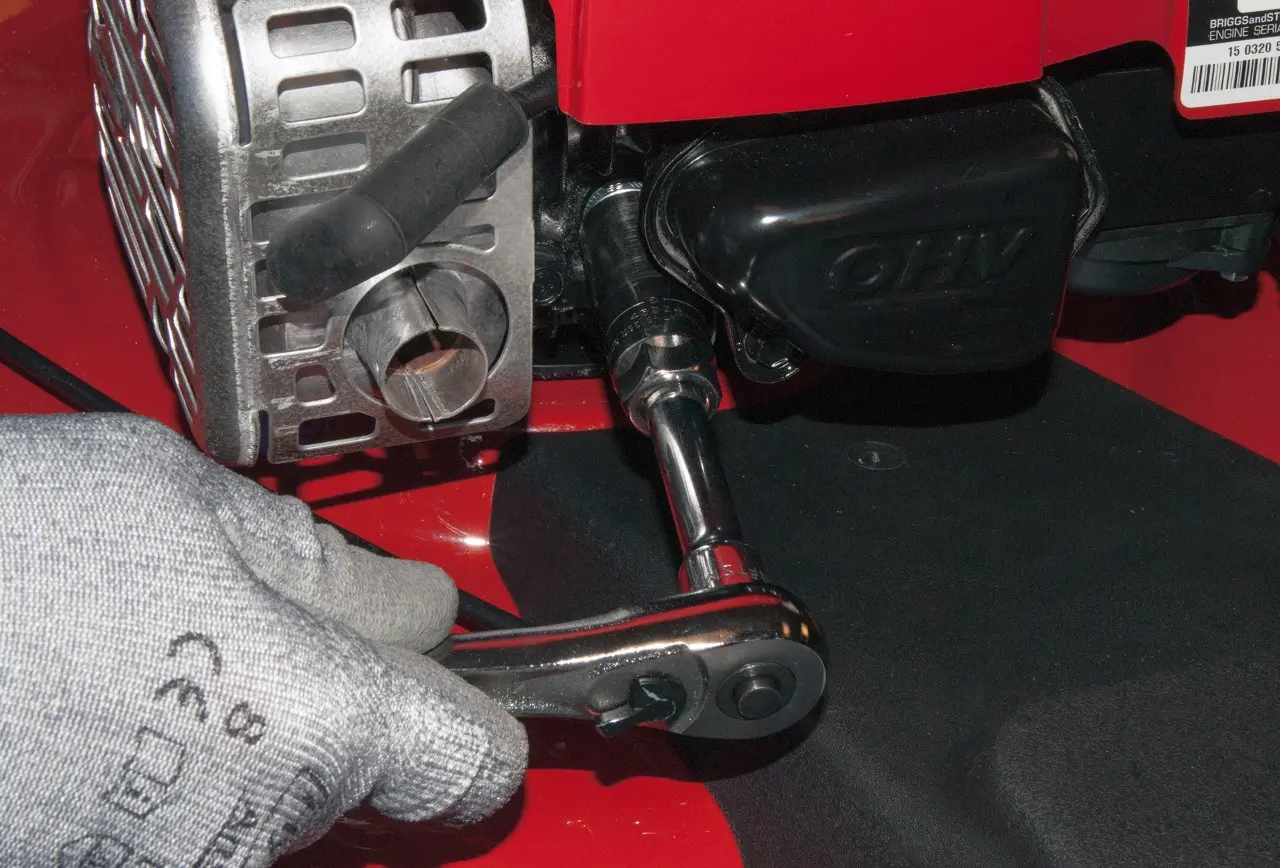
- Fit the spark plug socket over the plug. Push it on fully so it seats squarely. A loose fit can round the plug or crack the porcelain.
- Turn counterclockwise to loosen. Use steady pressure, not sudden force. The plug should break free after a short turn.
- Spin it out by hand. Once it is loose, remove the ratchet and unscrew the plug slowly. This gives you a better feel for resistance and protects the threads.
If the plug turns hard right away, stop and recheck the socket size and angle. Forcing the wrong tool can damage the hex head. If the plug feels stuck after only a quarter turn, use patience rather than muscle.
How to know when it is coming out correctly
A healthy plug usually loosens smoothly, then spins out with lighter resistance. If you feel grinding, cross-threading, or sudden binding, something is wrong. That could mean dirt in the threads, a mismatched socket, or corrosion from long storage.
Another clue is sound. A normal plug often gives a small “pop” when the seal breaks loose. That is fine. A squealing or crunching sound is not fine and usually means the plug or head is under stress.
What to do if the spark plug is stuck
A stuck plug is common on older mowers, especially if the engine sat unused for a long time. The most likely cause is corrosion on the threads. Heat cycles, moisture, and grass debris can all make the plug harder to remove.
Start with the simplest fix first. Spray a small amount of penetrating oil around the plug base, wait 10 to 15 minutes, then try again with steady pressure. Do not yank the ratchet. A slow, controlled motion works better and lowers the chance of stripping the aluminum cylinder head.

Credit: reddit.com
Simple troubleshooting steps
- Confirm the socket size is correct.
- Make sure the extension is seated straight.
- Try tightening the plug a tiny amount first, then loosening it again.
- Apply penetrating oil and wait before retrying.
- If the plug is rusted badly, stop before the hex head rounds off.
That last step is important. Many people keep forcing the plug and turn a small problem into a bigger repair. On some mower engines, the cylinder head threads are softer than the spark plug body, so damage happens faster than expected. Once the head threads are stripped, the repair becomes much more expensive than a plug swap.
When the plug should stop you
If the plug will not move after careful attempts, or if the metal around it looks cracked, call a small-engine repair shop. Do not use heat near a fuel system. Do not hammer the socket. And do not use an impact tool on a mower plug unless the manufacturer specifically allows it.
Also, if the plug boot, wire, or coil connection looks burned or broken, inspect the ignition parts before reinstalling anything. A bad wire can mimic a bad plug. That is one reason many people replace the plug and still have starting trouble.
How to inspect the plug after removal
Once the plug is out, look closely before you install a new one or put the old one back in. The tip tells you a lot about engine health. Light tan or gray deposits usually mean normal operation. Heavy black soot, oily buildup, or a wet tip can point to fuel, air, or oil issues.
Check the ceramic insulator for cracks. Look at the metal shell for rust or pitting. If the electrode is rounded, burned, or badly corroded, replace the plug. Many plugs are cheap enough that replacing them during routine maintenance is better than guessing.
| Plug condition | What it may mean | Best next step |
|---|---|---|
| Light tan or gray | Normal combustion | Clean and reuse if the plug is not worn |
| Black dry soot | Rich fuel mix or weak spark | Replace the plug and check air filter |
| Wet fuel | Flooding or no ignition | Dry the plug and inspect ignition |
| Oily deposits | Oil burning or worn engine parts | Inspect engine condition before reinstalling |
| Cracked porcelain | Physical damage | Replace immediately |
One less obvious insight: a plug can look “not too bad” and still fail under compression. If the mower struggles only when cutting thick grass, weak spark is often more obvious under load than in the driveway. That is why a visual check should be paired with replacement intervals from the engine maker.
How to install the spark plug correctly
Reinstalling the plug is just as important as removing it. Cross-threading happens when the plug starts crooked, and that can ruin the cylinder head. Always start the plug by hand for several turns before you use the ratchet.
- Thread the plug in by hand until it turns smoothly.
- Continue until it seats lightly.
- Use the socket to snug it down.
- Do not overtighten.
- Reconnect the spark plug wire firmly.
If you are using a new plug, check the gap before installation. The gap is the small space between the electrodes, and it must match the engine specification. A gap that is too wide can make starting harder, while a gap that is too narrow can weaken the spark.
Most small engines use a torque value in the range of 180 to 240 in-lb for a spark plug, but the exact number depends on the engine. If you do not have a torque wrench, tighten it snugly and stop. Over-tightening can strip the threads, while under-tightening can let combustion gases leak past the plug.

Credit: reddit.com
Common mistakes to avoid
- Pulling the plug wire by the cord instead of the boot
- Removing the plug from a hot engine
- Letting dirt fall into the cylinder
- Using the wrong socket size
- Cross-threading the new plug
- Overtightening the plug with too much force
Another detail many users miss: the plug boot should click or seat firmly when reattached. A loose boot can cause intermittent spark loss, especially on rough ground. If the mower starts then dies randomly, that connection is worth checking before you replace other parts.
How often to replace a mower spark plug
Many lawn mower engines use spark plugs that last one to two seasons, but interval recommendations vary by brand and engine size. Some plugs can last longer with light use, while dirty air filters and bad fuel shorten plug life. If your mower is hard to start every spring, a fresh plug is a sensible first step.
For best results, check the owner’s manual or the manufacturer’s support information for your exact engine model. If you want to confirm maintenance intervals from the source, use the official manufacturer support page as a starting point for manuals and service guidance.
Two non-obvious points matter here. First, spark plugs can fail before they look “old” if the engine runs rich or stores fuel for long periods. Second, replacing only the plug without checking the air filter can hide the real problem. A clogged filter can foul the new plug fast.
When replacement makes more sense than cleaning
Replace the plug instead of cleaning it if the electrode is worn, the threads are rusty, or the ceramic is damaged. Cleaning may get a mower running for a short time, but it does not fix wear. For most homeowners, a new plug is faster, safer, and more reliable than trying to save a badly used one.
If the mower still will not start after a new plug, the issue may be fuel delivery, stale gas, a dirty carburetor, or a failing ignition coil. At that point, the spark plug is only one part of the diagnosis, not the whole answer.
Final checks before you start the mower
Before pulling the starter rope or turning the key, do a quick walk-through. Confirm the plug is tight, the wire is fully connected, and no tools are left near the engine. Make sure the mower is upright and stable.
Then try the mower in a safe open space. If it starts faster, idles smoother, and runs better under cutting load, the plug work likely solved the issue. If it still struggles, you now know the plug is not the only problem, and you can move to fuel and air checks with more confidence.
For most owners, learning how to remove spark plug from lawn mower is one of the easiest maintenance skills to build. It saves time, helps you spot engine issues early, and keeps a small repair from turning into a bigger one.
Credit: searspartsdirect.com
FAQs
1. Can I remove a lawn mower spark plug without a special socket?
Sometimes, but it is not ideal. A spark plug socket grips the plug correctly and helps protect the porcelain. A regular socket may fit loosely and increase the chance of damage.
2. Should the mower be cold before removing the plug?
Yes. A cool engine is safer to work on and easier on your hands. Waiting 10 to 20 minutes after use is usually enough for a basic plug job.
3. What if the spark plug wire will not come off?
Hold the boot firmly and twist it gently while pulling straight off. Do not yank the wire itself. If it is stuck badly, a small amount of careful movement usually helps break it free.
4. How do I know if the plug is the reason my mower will not start?
If the plug is cracked, fouled, wet, or very worn, it is a strong suspect. A bad plug often causes hard starting, rough running, or stalling. If a new plug does not help, check fuel and air next.
5. Is it safe to reuse an old spark plug?
Yes, if it is clean, undamaged, and still within spec. But if the electrode is worn or the insulator is cracked, replace it. A new plug is usually the better choice for dependable starting.