
A dead battery is the most common reason a mower will not start, and how to jump start a lawn mower safely depends on the battery type, cable order, and a few simple checks. If you skip the wrong step, you can damage the mower’s electrical system or create a spark near fuel.
The good news is that most riding mowers and some battery-equipped models can be jump started in minutes. With the right setup, a charger or another vehicle, and a careful process, you can get back to mowing without guessing.
This guide shows the safest way to jump start a lawn mower, when to use a battery charger instead, and the mistakes that cause most problems. It also covers battery care, troubleshooting, and the signs that the battery may be too weak to recover.
Check the mower before you connect anything
Before you touch the cables, confirm that the battery is actually the problem. A mower that will not crank can also have a loose seat switch, bad fuse, dirty terminals, or a safety interlock that blocks starting. Many people skip this part and jump a mower that does not need a jump at all.
First, make sure the mower is in neutral, the blade control is off, and the parking brake is set. Remove the ignition key. If the mower smells like gas, do not keep trying to start it near an open flame or a smoking charger.
Signs the battery is the likely issue
- The starter clicks once, or clicks slowly.
- The engine turns very slowly.
- The dash lights are dim or dead.
- The mower started fine recently, then sat for 2 to 8 weeks.
- Battery terminals look white, green, or rusty.
If you have a multimeter, a fully charged 12-volt lawn mower battery usually reads about 12.6 volts or a little higher at rest. Around 12.2 volts is roughly half charged. Below 12.0 volts, many mower batteries struggle to crank well.
One non-obvious point: a battery can show decent voltage with no load and still fail the moment you try to start the engine. That means voltage alone does not prove the battery is healthy. Weak internal plates often show up only under load.
Use the right power source for the job
You have two common choices: a battery charger or a jump source. A charger is safer for a dead battery that has simply sat too long. A jump source is faster when you need the mower running right away and the battery still has some life left.
For many riders, a 12-volt jump from another vehicle, a jump pack, or a fully charged 12-volt battery works. Do not use a 24-volt source unless the mower manual clearly says so. Most lawn mowers use 12 volts, and too much voltage can damage the starter and electronics.
What you need
- Safety glasses
- Insulated jumper cables or a jump pack
- Gloves, if available
- A wrench or brush for dirty terminals
- Access to the mower battery
If your mower battery is hard to reach, check the owner’s manual for the exact location and charging instructions. The official mower safety guidance from the CPSC is also useful for basic safe handling around mower starting systems and blades.
Another detail many beginners miss: a jump start is not a repair. If the mower only starts with help every time, the battery may be sulfated, the charging system may be weak, or the terminals may be corroded. Jumping the mower over and over can hide the real problem.
How to jump start a lawn mower with jumper cables
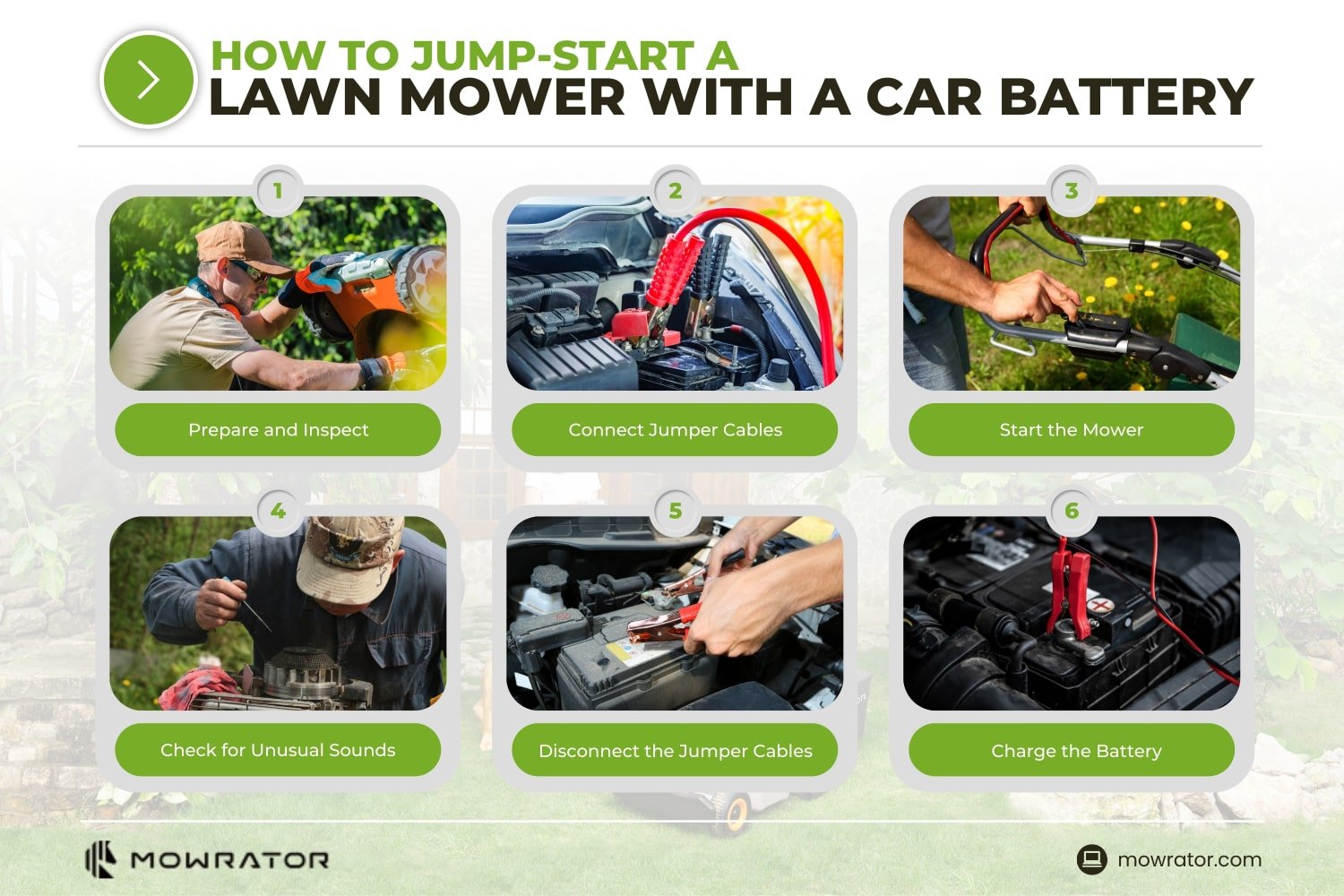
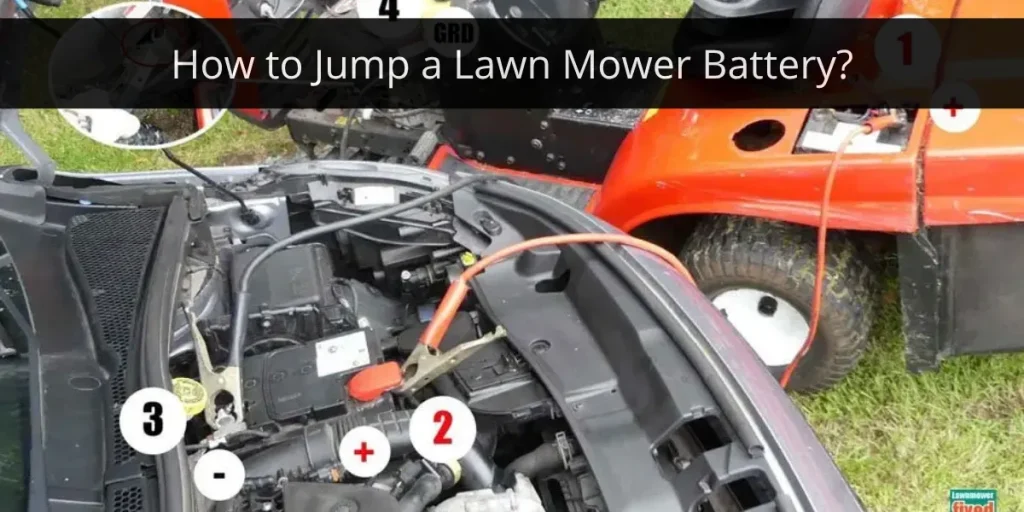
This is the most common method for riding mowers with a 12-volt battery. The key is to connect the cables in the correct order and keep the metal clamps from touching each other. That prevents sparks and protects the electrical system.
- Turn both machines off. Put the donor vehicle or battery source in park, with the engine off at first.
- Open both battery areas and identify the positive terminal, usually marked with a + sign and often covered in red.
- Attach the red clamp to the mower battery’s positive terminal.
- Attach the other red clamp to the donor battery’s positive terminal.
- Attach the black clamp to the donor battery’s negative terminal.
- Attach the last black clamp to a clean, unpainted metal part on the mower frame, away from the battery and fuel system.
- Start the donor vehicle if needed, or turn on the jump pack.
- Try starting the mower for 3 to 5 seconds.
- Once the mower starts, disconnect the cables in reverse order.
That frame-ground connection matters. It reduces the chance of a spark right next to the mower battery, where hydrogen gas can build up during charging. Many people clamp the last black lead directly to the dead battery’s negative terminal because it seems easier, but the frame is the safer choice in most cases.
Keep the cable clamps separated while connected. If they touch, you can short the batteries and create heat or sparks. Also, do not lean over the battery while making the final connection.
What if the mower still will not start?
Give it one more short attempt after waiting 30 to 60 seconds. If the starter only clicks or spins weakly, the battery may be too far gone, the cables may not be making good contact, or the starter may have its own problem. Corroded terminals are especially common and can block current even when the battery itself is fine.
If the engine starts but dies immediately, the problem may not be the battery. It could be fuel delivery, a bad switch, or a safety circuit issue. A jump start only helps if the battery is the weak point.
How to jump start a lawn mower with a jump pack
A jump pack is often the cleanest option. It is portable, simple, and does not require another vehicle. For many homeowners, this is the easiest way to handle a dead mower battery because the cables are shorter and the process is more controlled.
Connect the jump pack the same way you would connect jumper cables: red to positive, black to a grounded metal point on the mower frame. Then turn on the pack and try starting the mower. Most small jump packs are built for 12-volt systems, so check the label before using one.
Credit: mowrator.com
Why jump packs are often better than a car
- Less cable clutter.
- No need to start another engine.
- Lower chance of accidental contact between clamps.
- Usually easier for tight battery compartments.
One useful habit: wait 30 seconds after connecting the pack before cranking. That short pause can help the dead battery absorb a little surface charge, which sometimes gives the starter enough current to engage. It is not magic, but it can make a weak battery start more reliably.
If your jump pack has an anti-spark or reverse-polarity warning light, follow it closely. Those features help, but they do not remove the need for correct connection order.
Know when not to jump start
Some mower problems should not be solved with a jump start. If the battery case is swollen, cracked, leaking, or smells like rotten eggs, stop and replace it. Do not try to revive a damaged battery.
Also avoid jumping if the mower has been in rainwater, if you see melted wires, or if the battery cables are badly frayed. A shorted cable can heat up fast and create a fire risk. Safety comes first, even if the mower is urgent.
Cases where charging is better than jumping
- The mower sat unused all winter.
- The battery is low but not dead.
- You have time to charge for several hours.
- The battery is new and may only need a full recharge.
For a battery that is simply discharged, a smart charger is often the best choice. A 1 to 2 amp maintainer can restore charge slowly and safely. That is gentler than repeated jump starts, and it can help the battery last longer.
Battery health also depends on temperature. Cold weather can reduce usable battery power, while summer heat can age the battery faster. A battery that seems fine in spring may fail in late summer if it was already weak.
Fix the common causes after the mower starts
Once the mower is running, do a quick check so you do not end up in the same spot tomorrow. A successful jump tells you the mower can run, but it does not explain why the battery went flat in the first place.
Start with the terminals. Remove any white or green corrosion with a terminal brush and tighten the connections. Loose terminals can mimic a dead battery and create intermittent starting issues that are hard to track down.
Credit: tycorunenergy.com
Check the charging system
If the mower has an alternator or charging circuit, it should put energy back into the battery while the engine runs. A weak charging system may let the mower start after a jump but leave the battery dead again after the next use.
A simple test: after the mower runs for 15 to 20 minutes, shut it off and try starting again. If it struggles again, the battery may not be charging properly. At that point, the battery, belt-driven charging parts, or voltage regulator may need attention.
Look for hidden drains
Some mowers lose charge because of accessories or wiring faults. A bad ignition switch, faulty relay, or stuck light can slowly drain the battery even when the mower sits idle. This is common on riders with electric PTO systems or extra lighting.
To reduce battery drain, disconnect a battery tender during storage, keep the battery clean, and park the mower where temperatures stay moderate. A battery stored in extreme heat or cold loses strength faster than one kept in a dry garage.
Common mistakes that make jump starting harder
Most jump start failures come from a few simple errors. The good news is that they are easy to avoid once you know them.
- Connecting the clamps to the wrong terminals.
- Using a 24-volt source on a 12-volt mower.
- Clamping to painted metal instead of bare metal.
- Trying to start too long at once.
- Ignoring heavy corrosion on the terminals.
- Jumping a battery with visible damage.
One mistake people rarely notice is weak clamp contact. If the jaws only bite into dirt, oxidation, or paint, the mower may get just enough power to click but not enough to turn over. A quick cleaning can solve what looks like a dead battery.
Another common issue is cranking too long. Try for 3 to 5 seconds, then pause. Long cranking can overheat the starter and drain the donor source. Short attempts are safer and usually just as effective.
How to keep the battery from dying again
After you get the mower going, a few habits can prevent the next no-start problem. Battery care is simple, but it matters more than many owners expect. A mower battery that sits unused for 30 to 60 days can lose enough charge to become unreliable.
Store the mower with a battery maintainer if possible. Keep the terminals clean and tight. If the mower will sit for the off-season, charge the battery fully before storage and check it every 4 to 6 weeks.
Also avoid short, repeated starts when possible. If the engine only runs for a minute or two, the charging system may not replace the energy used to crank it. Longer runs are usually better for battery recovery.
If you mow in very dusty or humid conditions, inspect the battery area more often. Dirt and moisture can speed up corrosion, and corrosion steals current. That is one reason a battery can look “fine” and still perform badly.
| Situation | Best action | Why |
|---|---|---|
| Battery is slightly weak | Jump start once, then charge fully | Often recoverable |
| Battery sat unused for weeks | Use a smart charger first | Gentler than repeated jumping |
| Battery case is damaged | Replace the battery | Unsafe to charge or jump |
| Engine starts but dies again | Check charging system and connections | Battery may not be recharging |
Final takeaways before you try it
Knowing how to jump start a lawn mower safely is mostly about patience and correct connection order. Use a 12-volt source, connect positive first, ground the last black clamp to the frame, and keep each cranking attempt short.
If the mower starts, do not stop there. Clean the terminals, check the charging system, and watch for repeat failures. A mower that needs frequent jumps is telling you something important, and catching that early saves time later.
If you want the safest path, remember this simple rule: jump only a healthy, 12-volt mower battery with a proper source, and replace any battery that is swollen, cracked, or leaking. That keeps the process quick, controlled, and much less risky.
Credit: lithiumhub.com
FAQs
Can you jump start a lawn mower with a car?
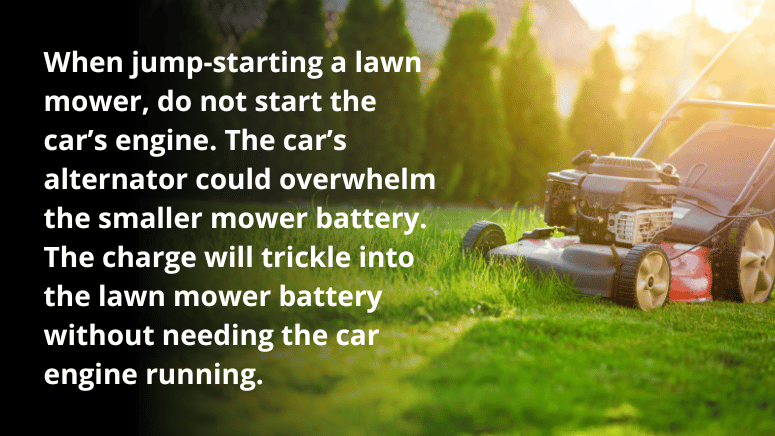
Yes, you usually can, as long as the mower uses a 12-volt battery and the car engine is off while you connect the cables. The battery order still matters: positive to positive, then negative to the car battery, and the final black clamp to the mower frame.
How long should I leave the jumper cables on before starting?
About 30 seconds to 1 minute is enough in most cases. That gives the dead battery a small surface charge and lets the connection stabilize. Longer waiting usually does not help much if the battery is badly worn out.
What voltage should a lawn mower battery have to start well?
A fully charged 12-volt lawn mower battery is usually around 12.6 volts or slightly higher at rest. Around 12.2 volts may still start the mower, but below 12.0 volts the battery often becomes too weak for reliable cranking.
Why does my mower click but not start after a jump?
A single click usually means the starter is getting some power, but not enough current to crank. The problem may be dirty terminals, weak cable contact, a very weak battery, or a starter issue. If the click repeats, check the battery connections first.
Should I replace the battery if the mower needs a jump start every time?
Yes, if the mower keeps needing a jump after a full charge, the battery may be near the end of its life. Before replacing it, check for corrosion and make sure the charging system works. If those are fine, the battery is usually the weak point.