
If you need to know what size battery for craftsman riding mower models use, the safe answer is usually a 12-volt lawn and garden battery that matches the mower’s tray, terminal layout, and cold-cranking amp needs. The exact battery is not “one size fits all,” because Craftsman riding mowers cover many years, engine sizes, and battery compartments.
The good news is that finding the right battery is simple once you check a few specs. You only need three things to match correctly: voltage, physical size, and terminal style. After that, you can compare reserve capacity and cold-cranking amps so the mower starts well in real yard conditions.
This guide shows you how to pick the right battery without guessing, what numbers to look for on the old battery or mower manual, and how to avoid the common mistakes that lead to weak starts or a battery that does not fit.
Start with the three specs that matter most
For most Craftsman riding mowers, the battery is a 12V lawn and garden battery. That is the first thing to confirm, because a mower battery is not chosen by brand name alone. The battery must also fit the tray and connect correctly to the cables.
The three specs that matter most are voltage, group size, and terminal layout. Voltage tells you the electrical system match. Group size tells you the physical case size. Terminal layout tells you whether the positive and negative posts line up with the cables without stress.
A battery can be “12V” and still be wrong for your mower if it is too tall, too wide, or has the posts on the wrong side. That is a mistake many buyers make. The mower may look like it should fit, but the cables can end up too short or the hold-down bracket may not lock it in place.
Typical battery size for Craftsman riding mowers
Many Craftsman riding mowers use batteries in the U1 family, especially U1 or U1R. These are common lawn tractor battery group sizes. They are compact enough for most riding mower trays, yet strong enough for starting small to mid-size engines.
A standard U1 battery is usually about 7.75 inches long, 5.12 inches wide, and 6.25 inches tall (about 197 x 130 x 159 mm). The U1R version is similar in size, but the terminal positions are reversed. That “R” matters more than many people think.
If the battery tray on your Craftsman mower is designed for a U1 battery, forcing in a larger group size can cause vibration, cable strain, or a loose hold-down. Those problems shorten battery life and can damage the mower wiring over time.
| Common battery group | Typical use | Approx. dimensions | Notes |
|---|---|---|---|
| U1 | Most riding mowers and lawn tractors | 7.75 x 5.12 x 6.25 in | Very common fit |
| U1R | Riding mowers with reversed terminal layout | 7.75 x 5.12 x 6.25 in | Same size as U1, different post position |
| Some larger group sizes | Certain heavy-duty or special models | Varies | Check manual before buying |
Why cold-cranking amps matter more than many buyers realize
Cold-cranking amps, or CCA, measure how well the battery can start the engine under load. For Craftsman riding mowers, a common range is roughly 150 to 300 CCA, depending on engine size and model needs.
Many people focus only on voltage and ignore CCA. That can work in warm weather, but in cooler conditions a low-CCA battery may spin too slowly. A battery with higher CCA than the minimum is usually fine, as long as it still fits the tray and matches the charging system.
Reserve capacity also matters, especially if your mower has lights or if you make repeated short starts. A battery with better reserve capacity can handle short use cycles better. That is useful because riding mowers do not charge like cars; they often run for limited periods and then sit for days.
How to check the battery your Craftsman mower actually needs
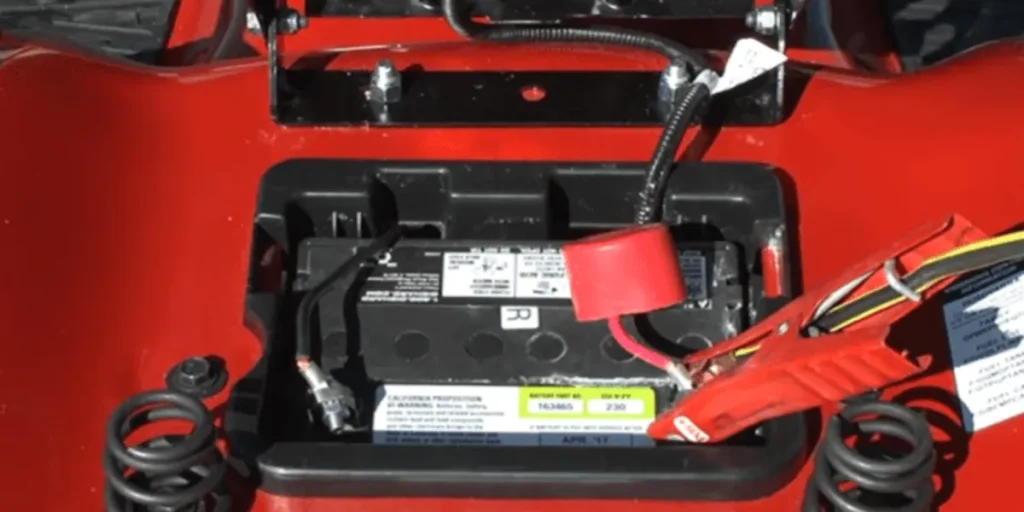
The fastest way to avoid a wrong purchase is to read the old battery label first. Most batteries have the group size, voltage, and CCA printed on the case. If the label is faded, take a photo from the side and top, then compare the shape and terminal position.
If the old battery is missing, the mower model number becomes your best guide. You can usually find it under the seat, on the frame, or near the rear fender. Craftsman model numbers help narrow down the battery tray size and terminal orientation.
If you want the most reliable reference, use the official owner’s manual for your exact mower model. The manual may list the recommended battery type or at least the battery compartment specs, which is more useful than guessing from similar-looking machines.
What to read on the old battery
Look for these markings:
- Voltage: usually 12V
- Group size: often U1 or U1R
- CCA rating: often 150, 200, 250, or 300+
- Terminal type: top posts on most mower batteries
- Polarity: which side is positive and which is negative
If the battery label shows “maintenance-free” or “sealed”, that is normal. Many modern lawn and garden batteries are sealed AGM or sealed lead-acid types. These usually need less care than old-style flooded batteries and are easier for most homeowners to use.
How to measure the battery tray
If the old battery is gone, measure the compartment with a tape measure. Record the length, width, and height, and leave a little room for the hold-down bracket. Do not measure loosely. Even a half-inch error can lead to a battery that fits on paper but not in real life.
Also check where the cables reach. The terminals should sit where the cable ends can connect without stretching. A battery with reversed terminal placement may technically fit in size but still be a bad choice if the cables cross too tightly.
Common Craftsman battery mistake to avoid
One easy mistake is buying the right group size but wrong terminal orientation. The U1 and U1R batteries often look almost identical. The difference is where the positive post sits. If the posts are reversed, the cables may not reach cleanly, or they may press against the seat pan or body panel.
Another common mistake is replacing a worn battery with a much bigger one just because it has a higher CCA rating. More power sounds better, but the mower tray may not allow it. A battery should fit securely first, then meet the electrical need.
Battery types you will see for Craftsman riding mowers
Most Craftsman riding mower batteries fall into one of two common types: flooded lead-acid or AGM. Both are 12V batteries, but they behave differently in storage, vibration, and maintenance.
Flooded batteries are often less expensive and can work well if maintained properly. AGM batteries are sealed, spill-resistant, and usually handle vibration better. That matters on a mower, because rough ground and deck vibration can shorten battery life.
The right choice depends on how you use the mower. If it sits unused for long periods, AGM often holds up better. If you use the mower regularly and keep it on a smart charger in the off-season, either type can work well.
Credit: whatsizebro.com
AGM vs flooded: what changes in real use
AGM batteries do not require water top-offs. That is a big plus for many homeowners. They also tend to recover better after storage and tolerate vibration well. On the other hand, they are usually more expensive than basic flooded batteries.
Flooded batteries can still be a solid choice if you check them during the season and keep the terminals clean. But if your mower lives in a hot garage or sees bouncing terrain, AGM often gives more stable performance over time.
Beginners often miss one detail: a mower battery can fail early not because of age, but because of repeated deep discharge. If you leave the key on, use accessories too long, or store the mower without charging it, even a good battery can lose strength fast.
What battery specs are usually enough
For many Craftsman riding mowers, a battery in the range of 12V, 150–300 CCA, and U1/U1R sizing is the normal fit. That is the practical starting point for most shopping decisions. If your mower has a larger engine or extra electrical load, choose the higher end of the CCA range when the tray allows it.
If you are unsure, checking the mower manual is safer than using a random online fit chart. Online charts can be wrong for older machines or models with running changes. Craftsman has used many different chassis and deck combinations over the years.
How to choose the right battery without buying twice
The best battery is the one that fits the tray, matches the posts, and starts the engine reliably. A smart purchase is less about finding the “strongest” battery and more about finding the one that matches your exact mower.
Start with the battery group size, then confirm terminal placement, then check CCA. That order matters. If you choose by CCA first, you may end up with a battery that is too large or has the wrong polarity.
Also check the battery hold-down system. Some Craftsman mowers use a strap or bracket that assumes a specific battery height. If the battery is too tall, the hold-down may not lock. If it is too short, the battery may bounce during use.
Credit: whatsizebro.com
Simple buying checklist
Before you order, confirm these points:
- 12-volt system
- U1 or U1R size, unless your manual says otherwise
- Terminal position matches the cable reach
- CCA rating meets or exceeds the mower’s need
- Physical dimensions fit the tray and hold-down
- Battery type works for your storage habits
That small checklist prevents most wrong purchases. It also helps if you are shopping in a store where the batteries all look similar. The box may say “lawn mower battery,” but that does not mean it is correct for your Craftsman model.
Where many buyers get confused
Some sellers list batteries by engine size, like 18 HP or 20 HP. That is not always reliable. Engine horsepower alone does not determine the battery size. The starter design, cable length, and tray space matter too.
Another common confusion is between battery size and physical voltage. A battery can fit physically and still be wrong electrically if it is not a 12V battery. Riding mowers in this category almost always use 12V, so a different voltage is a red flag.
Signs your current battery is the wrong size or failing early
If the mower starts slowly, clicks, or needs frequent charging, the battery may be weak. But a weak battery is not always the only problem. Loose cables, corroded terminals, and a dirty ground connection can produce the same symptoms.
If the battery slides in the tray, rocks under the hold-down, or the cables must be stretched tight, the size is likely wrong. That can also cause intermittent starting. Vibration makes poor connections worse, especially on uneven lawns.
Another clue is battery age. A typical mower battery lasts about 3 to 5 years with decent care. If yours is older than that and struggles after charging, replacement is often smarter than repeated recharging.
Quick diagnosis before replacement
- Check cable ends for corrosion or looseness.
- Clean the terminals and the frame ground point.
- Measure battery voltage after charging.
- Compare the battery dimensions to the tray.
- Confirm the battery is the same group size and terminal layout as before.
If the battery reads low right after a full charge, it may be worn out. If it reads fine but the mower still struggles, the starter, solenoid, or charging system may need attention. In that case, the battery size is not the whole story.
When to replace instead of recharge
Replace the battery if it will not hold a charge, if the case is swollen, or if it has trouble starting after repeated charging. A battery that has been deeply discharged many times often loses useful capacity even if it still looks normal from the outside.
If the mower is used seasonally, keeping the battery on a maintainer during storage helps. This is one of the easiest ways to get more life from the battery and avoid spring-start problems.
Installation tips that save time and prevent damage
Installing a mower battery is straightforward, but the details matter. Always disconnect the negative cable first and reconnect it last. That reduces the chance of accidental short circuits.
Clean the terminals before installation. A light layer of corrosion can weaken the connection enough to affect starting. Tight cables matter more than many people think, because a loose terminal can mimic a dead battery.
If your mower uses a battery strap or bracket, make sure it holds the battery firmly. A battery that moves during mowing can crack internally over time. This is one reason a perfect physical fit matters just as much as the electrical rating.
Safety note
Wear eye protection when handling a lead-acid battery. Battery acid and spark risk are both real. If the battery case is cracked, swollen, or leaking, do not install it. Dispose of it properly through a battery recycling program.
What size battery for Craftsman riding mower models most often need
For most Craftsman riding mower owners, the practical answer to what size battery for craftsman riding mower is a 12V U1 or U1R lawn and garden battery with enough CCA to start the engine reliably. In many cases, that means a battery in the 150 to 300 CCA range and a case size around 7.75 x 5.12 x 6.25 inches.
That said, the exact match still depends on the model number, year, and battery tray design. The manual or old battery label is the best guide. If those are missing, measure the tray and check terminal placement before buying.
The main lesson is simple: do not choose by Craftsman branding alone. Choose by fit, voltage, terminal position, and starting power. That approach saves money, avoids returns, and gives you a mower that starts the way it should.
If you want the safest path, match the old battery’s group size and terminal layout, then use the official manual as your final check. That is the most reliable way to get the right battery the first time.
FAQs
What size battery does most Craftsman riding mowers use?
Most Craftsman riding mowers use a 12V U1 or U1R battery. These are common lawn and garden battery sizes that fit many mower trays. Always confirm with your model number or old battery label before buying.
Can I use a higher CCA battery in my Craftsman mower?
Yes, if the battery still fits the tray and the terminals match. A higher CCA rating is usually fine and can help with stronger starts. The key is not to exceed the physical size limits or change the polarity layout.
What is the difference between U1 and U1R?
The size is usually the same, but the terminal position is reversed. That matters because the cables must reach the correct posts without strain. If you choose the wrong version, the battery may fit physically but still be hard to connect safely.
How long should a Craftsman riding mower battery last?
A well-kept battery often lasts 3 to 5 years. Storage habits, charging, vibration, and heat all affect battery life. Batteries that sit discharged for long periods usually wear out faster.
How do I know if my battery is bad or just discharged?
If the battery charges but loses power quickly, it may be worn out. If the mower starts after charging but fails again soon, that is another warning sign. Corroded terminals or loose cables can also make a good battery seem bad, so check those first.