
When a zero turn mower will not start, shuts off in the middle of mowing, or behaves in a strange way, the safety switch system is often the first place to check. On Toro machines, these switches are not just small parts. They are part of the main protection system that keeps the mower from starting or running when it should not. That is why toro zero turn safety switch problems can be so frustrating. A tiny fault can stop the whole mower.
The good news is that many of these problems are simple. A dirty connector, a loose seat switch, a damaged wire, or a misaligned pedal can create symptoms that look serious but are easy to fix. In other cases, the switch itself is not the real problem. The issue may be a fuse, a battery voltage drop, or a safety interlock that is not getting the right signal.
This guide explains how Toro zero turn safety switches work, why they fail, how to test them, and what to do next. It also shows common mistakes people make during troubleshooting, so you can avoid replacing the wrong part.
Quick locations and test order for Toro zero turn safety switches
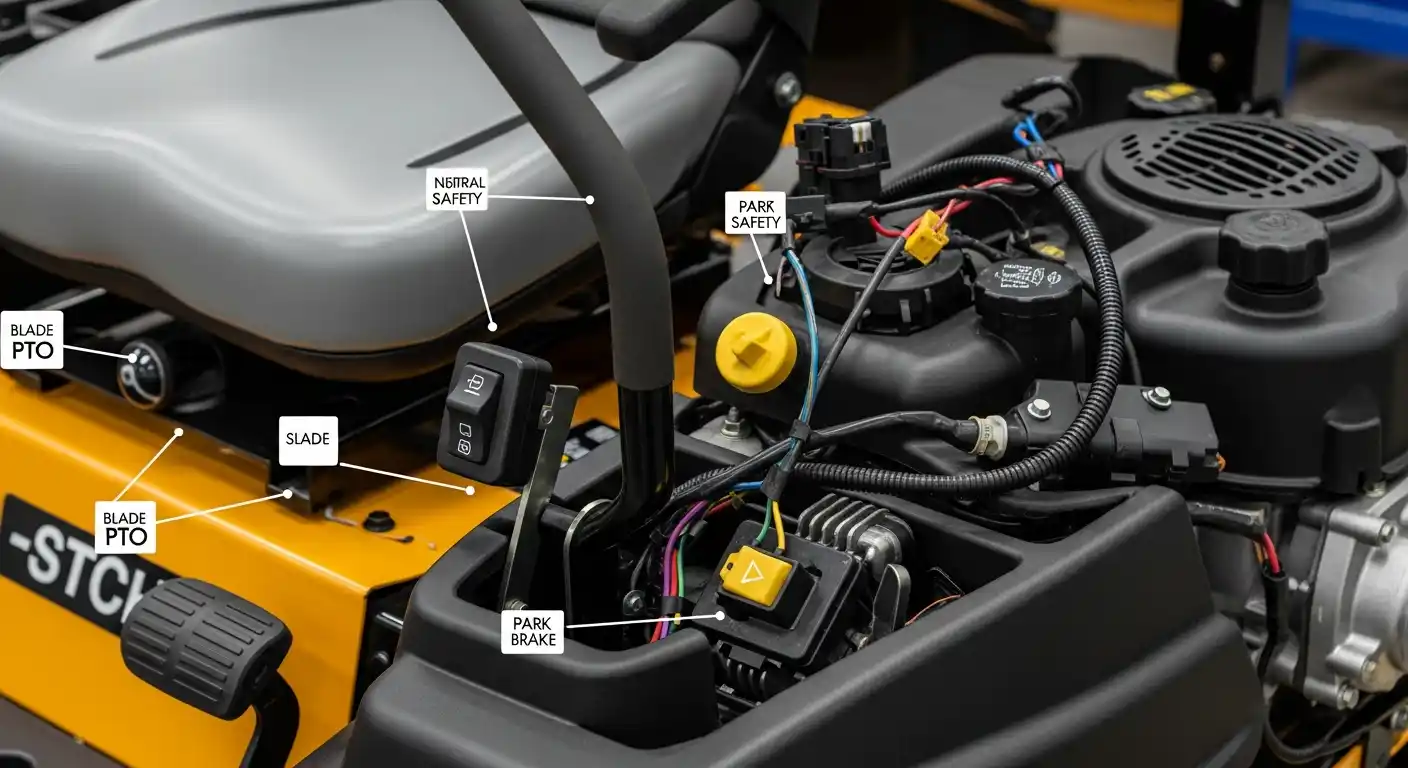
If you are trying to find the safety switch on a Toro zero turn, start with the operator controls instead of removing random covers. Most no-start and sudden-shutdown complaints come from the seat switch, parking brake switch, PTO switch, or neutral/control lever switches.
| Switch area | Common symptom | First safe check |
|---|---|---|
| Seat switch under the seat | Engine starts, then dies when the levers or PTO move | Inspect the plug, seat pressure, and switch mount before replacing the switch. |
| Parking brake switch near the brake linkage | No crank, no click, or start circuit stays locked out | Set and release the brake while watching whether the linkage fully presses the switch. |
| PTO or blade engagement switch on the dash/control panel | Starter will not engage, or blades will not turn on | Confirm the PTO is fully off for starting, then test continuity if the symptom remains. |
| Neutral/control lever switches near the handles | Mower only starts with the handles in a certain position | Check lever alignment, return-to-neutral movement, and loose connectors. |
For a broader no-start path, compare these interlock checks with why a lawn mower will not start. If the issue is on a Toro walk mower instead of a zero turn, use the Toro lawn mower starting guide. For electric Toro symptoms, the Toro Recycler electric troubleshooting guide is the better match.
How Toro safety switches protect the mower
Toro zero turn mowers use several safety switches to make sure the machine only runs under safe conditions. These switches act like simple on-off signals. If one of them sends the wrong signal, the mower may refuse to start or may shut down suddenly.
Most Toro zero turn models use some version of these switches:
- Seat switch – detects whether the operator is sitting on the mower
- Brake or parking brake switch – confirms the brake position
- Blade engagement switch – checks whether the PTO or blade control is off before starting
- Neutral or drive control switch – confirms the drive controls are in a safe position
- Battery and ignition circuit connections – support the electrical flow needed to start
These switches are part of an interlock system. If any one part is open, damaged, or out of position, the mower may stop working. That is why a problem that feels like a starter failure may actually be a switch issue.
Non-obvious insight: many people only test the switch itself, but not the mount or actuator. If the switch is fine but the seat or lever does not press it fully, the mower still fails. That mechanical alignment issue is easy to miss.
Common symptoms that point to switch trouble
Before replacing parts, it helps to match the symptom to the likely cause. Toro zero turn safety switch problems often show up in a few clear ways.
| Symptom | Possible switch-related cause | What it usually means |
|---|---|---|
| Mower will not start | Seat switch, brake switch, PTO switch, fuse, wiring | One safety signal is missing |
| Engine starts then dies | Seat switch, loose connector, vibration issue | The safety circuit opens after startup |
| Mower shuts off when hitting bumps | Loose switch, broken wire, weak connector | Intermittent electrical contact |
| Blades will not engage | PTO switch, seat switch, wiring issue | The control signal is blocked |
| No click when turning key | Ignition circuit, fuse, interlock switch | Power is not reaching the start circuit |
If your Toro shows one of these signs, do not jump straight to buying a new switch. Start with the basics. Many problems come from simple things like dirt, corrosion, or a connector that has worked loose over time.
Main causes of Toro zero turn safety switch problems
1. Dirt, grass, and moisture build-up
Zero turn mowers work in tough conditions. Grass clippings, dust, and water can get into switch areas. A seat switch or brake switch may be exposed to vibration and debris every time you mow. Over time, this buildup can cause weak contact or a switch that sticks.
This is especially common after washing the mower or storing it outside. Moisture can create temporary failure. The mower may work again later, which makes the issue confusing.
2. Loose or damaged wiring
Wires near the seat, control levers, and frame often move during use. If a wire bends too much, it can break inside the insulation. The outside may look fine while the inside is open. This can create a problem that comes and goes.
Loose connectors are another common cause. A plug may look attached, but not locked all the way in. A small vibration then breaks the circuit.
3. Worn switch contacts
Safety switches are mechanical parts. Like any mechanical part, they wear out. The internal contacts can become weak, corroded, or inconsistent. The switch may still click, but it may not send a clean signal.
Non-obvious insight: a switch can test fine at rest and still fail under pressure. In other words, the problem may not show until the mower vibrates, the seat shifts, or the lever changes position. That is why intermittent issues are harder to diagnose than complete failures.
4. Misaligned seat or control mechanism
If the seat is not mounted correctly, or if a lever, rod, or actuator is slightly bent, the safety switch may never get fully pressed. The mower then acts as if someone is not seated or a control is in the wrong position.
This happens after repairs, rough use, or when the seat has been replaced with a part that does not match perfectly.
5. Fuse or battery voltage problems
A weak battery can create symptoms that look like switch failure. If voltage drops too low during cranking, the safety circuit may not work as intended. A blown fuse can also interrupt the interlock system.
Always check electrical supply before blaming the switch. A switch cannot work properly if the circuit feeding it is weak.
6. Previous repair mistakes
Sometimes the trouble starts after someone has already worked on the mower. Reversed connectors, pinched wires, or the wrong replacement part can create fresh problems. This is one reason it helps to keep track of what was changed before the issue began.
How to troubleshoot the problem step by step
The best way to handle Toro zero turn safety switch problems is to follow a simple process. Do not guess. Do not replace three parts at once. Work through the mower in a logical order.
Credit: lawnask.com
Step 1: Check the obvious safety positions
Make sure the parking brake is set, the blade switch is off, and the drive controls are in the proper neutral position. Also confirm that the operator is seated correctly if the model requires it.
Some starting problems are caused by small position errors. A lever may look centered but not be fully in the right spot.
Step 2: Inspect the battery and fuse
Check battery terminals for corrosion and tightness. Clean them if needed. A weak connection here can make the whole system act strange. Then inspect the fuses related to ignition and safety circuits.
If the battery is old or has been sitting unused, test its voltage. A mower can fail to start even when lights or accessories still work.
Step 3: Look closely at the switch area
Find the switch connected to the symptom you are seeing. For example, if the mower dies when you rise from the seat, inspect the seat switch. If the blades will not engage, inspect the PTO switch and its wiring.
Look for:
- Broken plastic housing
- Loose mounting screws
- Rust or dirt around the switch
- Pulled, pinched, or frayed wires
- Connectors that are not fully seated
Step 4: Move parts by hand and watch for changes
With the mower off and the key removed, move the seat, levers, or switch actuator slowly. If the switch clicks only at one angle, or if the symptom changes when you touch the part, you may have an alignment issue rather than a dead switch.
Step 5: Test continuity with a multimeter
If you know how to use a multimeter, test the switch for continuity. A good switch should open and close cleanly based on its position. If the reading jumps around, the switch may be failing internally.
Follow the mower service guide for the exact test points for your model. Toro models can differ, so the wiring layout may not be identical across machines.
For official safety advice and mower operation guidance, Toro’s support resources and manuals are useful, and general small-engine safety information from the U.S. Consumer Product Safety Commission can also help you understand safe repair habits.
Step 6: Test the wiring, not just the switch
Use the meter to check whether power reaches the switch and leaves it correctly. A switch with good continuity is not useful if the wire before or after it is open. This is where many people waste time replacing a part that was not the true cause.
Step 7: Wiggle-test the circuit
With care, move the harness and connectors lightly while watching the meter or checking the symptom. If the reading cuts in and out, the fault is likely in the harness or connector, not the switch body.
Simple fixes that solve many cases
Credit: justanswer.com
Clean the switch and connector
If the switch area is dirty, use a dry brush or electrical contact cleaner. Remove packed grass and wipe off moisture. Do not soak the switch unless the product is safe for electrical parts.
Tighten mounting hardware
A loose switch can move just enough to fail. Tighten screws, brackets, and seat mounts. Make sure the actuator reaches the switch fully when the control is in the correct position.
Repair or replace damaged wires
If a wire is cut or cracked, repair it properly. Use quality connectors and make sure the repair is protected from rubbing and vibration. A weak repair may work for a few days and then fail again.
Replace a clearly bad switch
If the switch does not test correctly, replace it with the correct Toro-compatible part. Do not use a random universal switch unless the fit, rating, and action match the original design.
Charge or replace the battery
If voltage is low, recharge the battery fully and test it again. If it will not hold a charge, replace it. Many owners chase switch problems for days when the real issue is poor battery performance.
Mistakes that make troubleshooting harder
A few common mistakes can turn a small repair into a long, expensive problem.
- Replacing the switch before checking wiring – a bad connector can look like a bad switch.
- Ignoring intermittent symptoms – if the mower fails only on bumps, vibration and loose wiring should be the focus.
- Forcing connectors apart – this can damage clips and make the problem worse.
- Using the wrong test method – not every switch fails the same way, so test according to the circuit.
- Skipping the alignment check – a good switch in the wrong position still fails.
Another mistake is cleaning only the visible side of the mower. Switch problems often hide underneath the seat pan or along the frame where grass and moisture collect. Take time to inspect the full route of the wiring, not just the part you can see from above.
When the problem is not really the switch
Some symptoms look like safety switch failure but come from other parts of the system. This is important because the wrong repair wastes time and money.
Starter relay or solenoid issues
If the key turns but you hear a click and nothing else happens, the starter circuit may be the issue. A safety switch can still be involved, but the solenoid may also be weak or failing.
Ignition switch failure
The key switch itself may be worn. In that case, the mower can lose power to the safety circuit even though all the interlock switches are fine.
Engine shutdown from fuel or spark problems
If the mower starts and dies after a few seconds, do not assume the seat switch is guilty right away. Fuel delivery or ignition problems can create similar symptoms. That is why it helps to watch whether the engine dies instantly when a safety condition changes, or whether it fades out on its own.
Control lever neutral adjustment
Some Toro machines require the control levers to be in a very exact position. If the neutral setting drifts, the interlock system may block starting. This is a setup issue, not a broken switch.
How to prevent future safety switch problems
Once the mower is fixed, a little maintenance can prevent the same issue from returning.
- Keep the underside and switch area free of packed grass
- Store the mower in a dry place when possible
- Check seat mounting bolts and control hardware often
- Inspect harnesses after rough use or transport
- Test the battery before the mowing season starts
- Do not pressure wash electrical areas directly
Non-obvious insight: vibration is one of the biggest enemies of switch systems on zero turn mowers. A repair can look perfect in the garage and still fail in the field if the harness is not secured properly. Small tie-down fixes can matter more than many owners expect.
When to call a technician
Some problems are safe for a homeowner to handle. Others need professional help. Call a technician if you find burnt wiring, repeated fuse failure, damaged harness sections, or a problem that returns even after you replace the switch and clean the connectors.
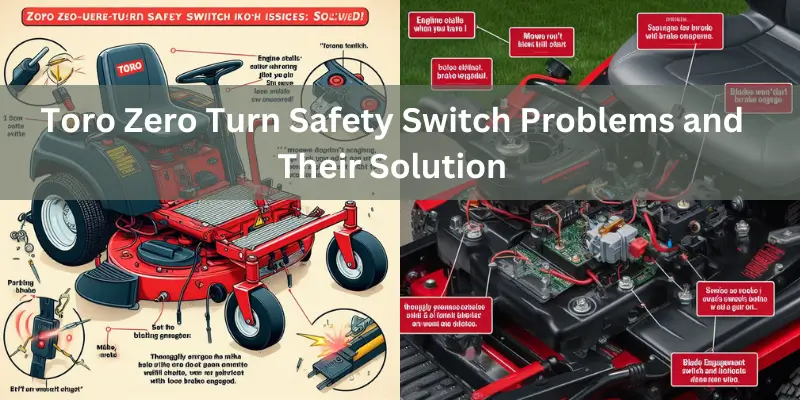
It is also smart to get help if you do not have a multimeter or if the mower keeps shutting off in a way that is hard to reproduce. Electrical faults that come and go can take time to trace, and a technician may diagnose them faster with proper test tools.
Credit: greenryenthusiast.com
Final thoughts
Toro zero turn safety switch problems can feel bigger than they are. In many cases, the fix is not a major repair. It is a loose connector, dirty contact, weak battery, or misaligned part. The key is to follow a calm process: check the basics, inspect the switch area, test the wiring, and only then replace parts.
If you take your time and look at the full safety circuit, you can solve most issues without guesswork. That saves money, reduces downtime, and keeps the mower working the way it should.
FAQs
1. Why does my Toro zero turn mower start only sometimes?
This often points to an intermittent safety switch problem. A loose connector, weak battery, or worn seat switch can work one moment and fail the next. Vibration usually makes the symptom worse.
2. Can a bad seat switch stop the mower from starting?
Yes. On many Toro zero turn models, the seat switch is part of the starting safety circuit. If it does not detect the operator correctly, the mower may refuse to start or may shut off after starting.
3. How do I know if the switch is bad or just out of alignment?
If the switch tests fine with a multimeter but the mower still fails, check the mounting position and actuator movement. If moving the seat or lever slightly changes the symptom, alignment is likely part of the problem.
4. Should I replace the switch or the whole wiring harness?
Replace only the failed part if the damage is local. If the wires are cracked in several places, the harness is badly worn, or the connector is burned, a larger repair may be the better choice.
5. What is the safest first step before testing Toro safety switches?
Turn off the mower, remove the key, disconnect the spark plug wire if needed, and make sure the machine cannot move. Safety systems protect the operator, so test them carefully and never bypass them for normal use.