
A bad ignition coil can make a lawn mower hard to start, weak under load, or dead with no spark. If you want to know how to test a lawn mower coil, the good news is that you can narrow it down with a few simple checks before buying parts.
You do not need a full shop setup. A spark tester, a basic multimeter, and a careful step-by-step process are enough for most small engines. The trick is to test the coil the right way, because many “bad coil” symptoms also come from a dirty plug, a loose kill wire, or a damaged flywheel key.
This guide shows the practical tests that matter, the common mistakes people make, and how to tell when the coil is truly the problem. You will also learn what readings to look for, when a no-spark issue is not the coil, and how to stay safe around the ignition system.
What a mower coil actually does
The ignition coil is the part that turns low voltage into the high voltage needed to fire the spark plug. When the flywheel spins, magnets pass the coil and create current. That current is boosted into a spark strong enough to ignite the fuel mix in the cylinder.
On most push mowers and many riding mowers, the coil sits close to the flywheel. The gap between the coil and flywheel is usually tiny, often around 0.010 to 0.014 inches on many small engines, though exact specs vary by model. If that gap is wrong, spark can get weak or vanish completely.
Here is the part many beginners miss: a coil can fail in two ways. It can die completely, which gives you no spark at all, or it can fail when hot, which means the mower starts cold and quits after 10 to 20 minutes. That second problem is easy to confuse with fuel trouble.
Common symptoms of a bad coil
- No spark at the plug.
- Hard starting, especially after sitting.
- Stalling when the engine warms up.
- Misfiring under load or in thick grass.
- Intermittent spark that comes and goes.
Tools and checks to prepare before testing
Before testing, gather a few basic tools. You do not need expensive equipment, but the right tools make the result much more reliable. A simple spark tester is better than judging spark by holding the plug wire near metal, which is unsafe and misleading.
Use this short prep list before you start:
- Socket wrench or nut driver.
- Spark plug wrench.
- Inline spark tester.
- Multimeter with ohms setting.
- Feeler gauge or a thin business card for coil gap checks.
- Clean rag and a brush.
It also helps to remove the spark plug and inspect it first. A fouled plug can mimic a bad coil. If the plug is cracked, carbon-covered, or worn past its service limit, replace it before testing anything else. A weak plug can make a good coil look bad.
For safe handling around ignition and small engines, the official safety guidance from OSHA is a useful reminder to disconnect power sources and avoid contact with moving parts while working.
How to test a lawn mower coil step by step
The most reliable way to test a mower coil is to start with the spark test, then move to resistance checks, then inspect the coil gap and kill wire. This order saves time because it separates a true ignition problem from a wiring or setup issue.
1. Confirm whether you have spark
Remove the spark plug wire and connect it to an inline spark tester. Ground the tester according to its instructions, then crank the engine. A bright, regular spark means the coil is likely working at least well enough to fire.
If you see no spark, or only a weak orange spark, move to the next checks. A strong blue spark is more reliable than a thin yellow spark. Weak spark often points to a coil, plug, or grounding problem.
2. Inspect the spark plug first
Take the plug out and examine it carefully. Clean off light carbon deposits, but replace the plug if the electrode is damaged, oily, or badly worn. Set the plug gap to the mower maker’s spec if needed, often around 0.020 to 0.030 inches on many small engines, though you should verify the exact model.
Do not skip this step. A bad plug is one of the most common reasons people think they have a coil failure. Testing a coil with a damaged plug can lead to the wrong diagnosis.
3. Check the kill wire
The kill wire shuts the engine off when you release the safety control or turn the key. If this wire is shorted to ground, it can stop spark completely. Disconnect the kill wire from the coil and test spark again.
If spark returns after removing the kill wire, the coil may be fine. The real issue is often a switch, harness, or safety control. This is one of the most overlooked causes of no-spark problems.
4. Measure coil resistance with a multimeter
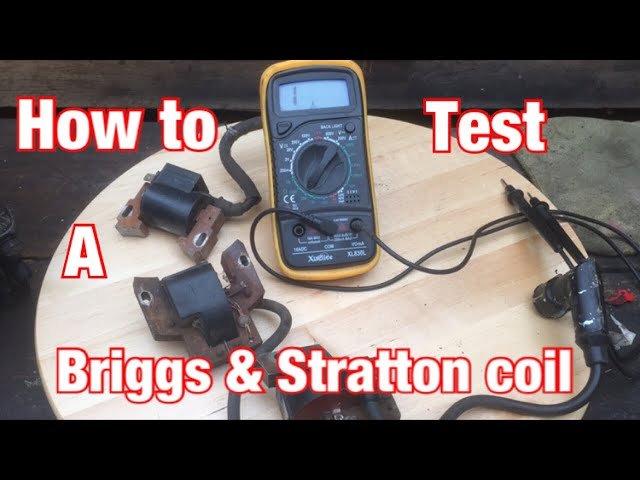
Set your multimeter to ohms and measure the primary and secondary windings if your coil style allows it. Not every mower coil gives easy access to both readings, but when it does, compare your result with the service specifications for your exact engine.
| Test point | What it checks | What a problem can mean |
|---|---|---|
| Primary winding | Low-resistance coil circuit | Open circuit, internal short, or failed winding |
| Secondary winding | High-voltage output path | Weak spark, no spark, or breakdown under load |
| Kill wire to ground | Unwanted grounding | Engine will not spark when wire is connected |
Resistance readings vary by engine design, so do not treat one generic number as universal proof. A reading outside the manufacturer range is useful, but a coil can still fail even if ohms look normal. That is why spark testing matters more than resistance alone.
5. Inspect the coil gap to the flywheel
Remove the blower housing if needed and check the coil position near the flywheel. Use a feeler gauge or a thin business card to set the gap. Many small engines work with a gap near 0.010 to 0.014 inches, but always check the correct spec for the engine you are servicing.
If the gap is too wide, spark can get weak. If it is too tight, the coil can rub the flywheel and create noise, damage, or a no-start condition. A gap that looks “close enough” is not always close enough.
6. Look for flywheel key damage
A damaged flywheel key can throw off ignition timing. That means the coil may be fine, but the spark happens at the wrong moment. This often happens after the blade hits a rock or stump.
If the engine suddenly started acting badly after a hard impact, check the key. A slightly sheared key can create confusing symptoms like kickback, backfiring, or hard starting. This is a classic non-obvious issue that often gets blamed on the coil.
7. Re-test spark after each change
After every correction, test spark again. That tells you which change fixed the problem. If spark returns after unplugging the kill wire, the coil is not the main fault. If spark returns after correcting the gap, the coil was not the problem either.
This step-by-step approach saves money and avoids random parts swapping. In many cases, the coil is replaced too early when the real issue is a bad plug, poor grounding, or a misaligned flywheel key.
Reading the results the right way
Testing is only useful if you know what the result means. A no-spark reading does not automatically prove the coil is dead. It only tells you the ignition system is not producing spark at that moment.
Here is a simple way to interpret the results:
- No spark with the kill wire connected, but spark returns when disconnected: the coil is usually fine; look at the switch or wire.
- No spark even with the kill wire removed: suspect the coil, spark plug, flywheel key, or coil gap.
- Weak spark only when hot: coil breakdown is possible, especially if the engine dies after warming up.
- Good spark but engine still will not run: the problem is likely fuel, compression, or timing, not the coil.
One useful trick is to test the mower both cold and hot. A coil that fails only after 15 minutes may pass every cold test. That is why some users replace fuel parts over and over before finding the real issue.
Credit: smart.dhgate.com
How to separate coil failure from fuel problems
If the engine starts on spray but dies soon after, people often assume fuel delivery is the issue. That may be true, but if spark disappears when the mower gets warm, the coil is a stronger suspect. Fuel problems usually do not cause a complete, repeatable no-spark condition.
Also watch for vibration-related faults. Loose coil screws, damaged wiring, or intermittent grounding can make the engine fail only when the mower shakes on rough grass. That kind of problem can be maddening unless you test while gently moving the harness and kill wire.
Common mistakes when testing a mower coil
Most bad diagnoses come from a few simple mistakes. The first is testing spark by holding the plug wire near metal with bare hands. That is unsafe and can give false results because the spark path is not controlled.
The second mistake is skipping the kill wire check. Many people replace a perfectly good coil when the real issue is a stuck safety switch. The third mistake is ignoring the flywheel key after a blade strike. That can change timing enough to make a good coil look bad.
Another common problem is trusting one meter reading too much. Resistance tests are helpful, but they do not catch every internal coil failure. Heat-related breakdowns often show up only under real operating conditions, not on a bench.
Credit: pinterest.com
When the coil is likely bad
- No spark after the plug, gap, and kill wire are verified good.
- Spark disappears as the engine warms up.
- The coil shows visible cracks, rust, or melted insulation.
- Resistance readings are far outside the service range.
- The coil rubs the flywheel and cannot be set correctly.
When the coil is probably not the issue
- The mower has spark, but it still will not start.
- Spark returns as soon as the kill wire is disconnected.
- The engine died right after a blade impact and the flywheel key is damaged.
- The spark plug is cracked, fouled, or gapped wrong.
Safety and replacement tips that save time
Always disconnect the spark plug wire before working near the blade, flywheel, or coil. If your mower has a battery, disconnect it too. Small engines can start unexpectedly if the ignition circuit is still energized.
When replacing a coil, match the part by engine model, not just by appearance. Two coils can look almost identical and still have different mounting holes or timing specs. That is why checking the engine code matters more than guessing from photos.
Torque the coil screws snugly, but do not overtighten and strip the housing. After installation, rotate the flywheel by hand to make sure nothing rubs. Then recheck spark before putting the cover back on.
If you are unsure about the correct service procedure for your model, the official owner’s manual and support resources can help you confirm gap specs, wiring layout, and ignition details for many small engines.
Fast troubleshooting path for a no-spark mower
If you want the shortest path to a real answer, use this order. It reduces guesswork and helps you avoid replacing parts that still work.
- Check the spark plug condition and gap.
- Test for spark with an inline tester.
- Disconnect the kill wire and test again.
- Inspect coil gap to the flywheel.
- Check for flywheel key damage after any impact.
- Measure coil resistance if your coil supports it.
- Replace the coil only if the evidence points to failure.
That order is simple, but it works. It starts with the easiest checks and ends with the more technical ones. Most homeowners solve the problem before reaching step 6.
Bottom line: the best way to learn how to test a lawn mower coil is to test spark first, then isolate the kill wire, gap, and flywheel key before replacing the coil. That process is faster, safer, and far cheaper than guessing.
Credit: lawnandmowers.com
Frequently asked questions
How do I know if my lawn mower coil is bad?
The most common sign is no spark at the plug after the plug, kill wire, and coil gap have been checked. A coil that fails only when hot is also a strong sign of internal breakdown.
Can a coil test good and still be bad?
Yes. A coil can pass a basic ohms test and still fail under heat or vibration. That is why a real spark test is more useful than resistance alone.
What tools do I need to test a mower coil?
A spark tester, a multimeter, a spark plug wrench, and a feeler gauge are usually enough. A clean spark plug and basic hand tools also help you rule out simple problems first.
Will a bad coil cause no spark at all?
It can, but not always. Some bad coils produce weak or intermittent spark, especially when the engine gets hot. Others fail completely and give you no spark from the start.
Should I replace the coil or the spark plug first?
Replace or test the spark plug first if it is old, dirty, cracked, or gapped wrong. Many no-start problems come from the plug, not the coil, and that simple fix can save you time and money.