
If your mower will not start, where to spray starter fluid lawn mower is usually the first question people ask. The short answer: spray a very small amount into the carburetor air intake, not into the spark plug hole, fuel tank, or air filter box.
That matters because starter fluid is a fast-igniting vapor, and the wrong spray location can damage parts or create a safety risk. Used the right way, it can help you tell whether the problem is fuel delivery, spark, or something more serious.
Below, you will get the correct spray spot, the safe way to use starter fluid, common mistakes, and what the mower is telling you if it still does not start. The goal is simple: help you diagnose the problem without making it worse.
Before using starting fluid, compare your symptoms with why a lawn mower will not start, how to remove a lawn mower spark plug, and how to clean a lawn mower air filter. Starter fluid is only a quick test; it should not replace fuel, spark, air, and compression checks.
The exact place to spray starter fluid on a lawn mower
On a push mower, the safest test spot is still the carburetor throat or air intake after the air filter is removed. Use only a very short burst, reinstall or hold the air filter housing safely out of the way, and keep the spray away from the muffler, spark plug boot, battery, and hot engine parts. If the mower starts for a second and dies, the test points toward a fuel-delivery problem rather than a starter-fluid problem.
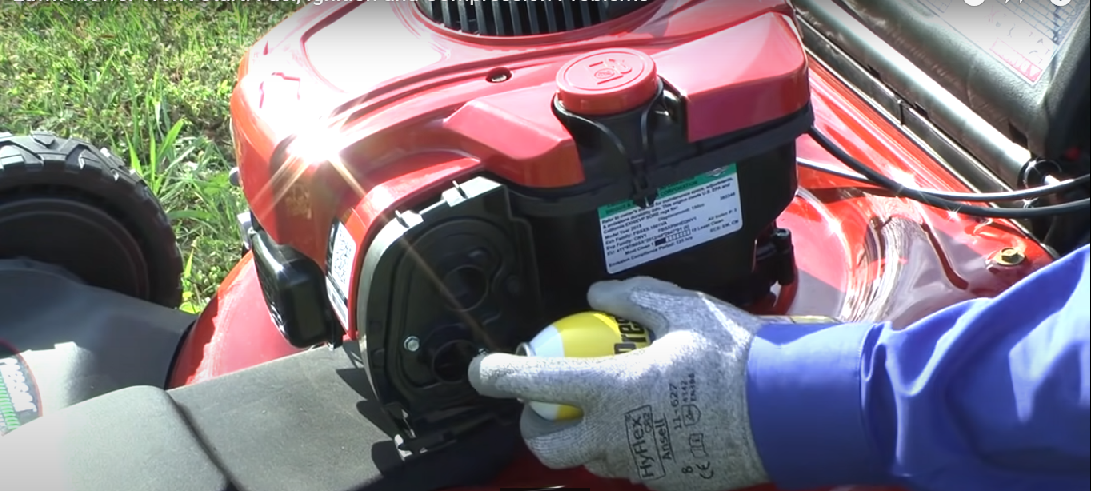
The correct place to spray starter fluid on a lawn mower is the carburetor intake, which is the opening where air enters the engine before mixing with fuel. On many mowers, this means removing the air filter cover and the air filter, then giving a brief spray into the intake throat of the carburetor.
If you can see the carburetor, spray 1 short burst only. A half-second spray is usually enough. You are not trying to flood the engine. You are just giving it a temporary fuel source to see if it will fire.
Do not spray starter fluid into the spark plug hole. Do not spray it into the gas tank. Do not soak the air filter. If the air filter is paper, it can become damaged. If it is foam, too much fluid can make the engine run badly for the first few seconds.
On most walk-behind mowers, the carburetor sits behind the air filter housing near the engine side of the mower. On riding mowers, the access is often similar, but the cover shape and position vary by model. If you are not sure, look for the side of the engine where the air filter box mounts. That is the area you want.
How to find the carburetor intake fast
Here is the easy way to locate it:
- Find the air filter cover on the engine.
- Remove the cover and the air filter.
- Look inside the opening where the filter was sitting.
- That opening leads to the carburetor intake.
If the engine has a plastic air cleaner housing, the intake is usually just behind it. If you see a metal throat or a round opening, that is often the correct spray point. If you see throttle linkages or a choke plate, you are very close.
Some small engines have a primer bulb instead of a choke. On those models, starter fluid is still sprayed into the intake, but only as a diagnosis tool. The idea is the same: if the engine briefly runs on starter fluid, fuel is likely not reaching the carburetor properly.
How to use starter fluid safely on a mower
Starter fluid is not a fix. It is a test. Used incorrectly, it can cause backfire, flash fire, or damage to plastic parts. Used correctly, it gives you a fast clue about what is wrong.
Before spraying, make sure the mower is outdoors or in a very open area. Keep the ignition source away. That means no cigarettes, no open flame, and no sparks from nearby tools. Starter fluid is extremely flammable, even in small amounts.
For a basic safety check, use the official mower safety guidance from the U.S. Consumer Product Safety Commission. It is a useful reminder that small engine work can go wrong quickly if fuel vapors build up.
Safe steps before you spray
- Turn the mower off and let hot parts cool.
- Remove the key, if it has one.
- Disconnect the spark plug wire for extra safety while inspecting.
- Open the air filter cover.
- Check that the air filter is not completely clogged.
- Reconnect the spark plug wire only when you are ready to test start.
If the mower has been sitting with old fuel for more than 30 days, that fuel may be part of the problem. Old gasoline can form varnish and clog the carburetor jets. In many cases, the starter fluid test only confirms what the stale fuel already suggests.
Use the smallest amount possible. A large spray does not improve the test. It only increases the chance of a backfire or a flood. One quick burst is enough for most small engines.
What the result tells you after the spray test
The starter fluid test is useful because it separates a fuel problem from other problems. If the engine starts for a second or two and then dies, that usually means the engine has spark and compression, but fuel is not getting through correctly.
If the mower does not even try to fire, the issue may be spark, compression, a blocked intake, or a safety interlock problem. In other words, starter fluid is not magic. It only tells you which system deserves your attention first.
| Test result | What it usually means | Next step |
|---|---|---|
| Starts briefly, then dies | Fuel is not reaching the engine correctly | Check fuel flow, carburetor, fuel filter, and old gas |
| No response at all | Spark, compression, or safety switch issue | Check spark plug, plug wire, blade brake, and compression |
| Backfires or pops | Timing, ignition, or too much starter fluid | Stop testing and inspect ignition parts |
One detail many people miss: if the mower only runs on starter fluid, the carburetor may be more than “dirty.” The main jet may be blocked, the fuel inlet needle may be stuck, or the tank vent may not be letting air in. That is why the symptom matters as much as the test itself.
Another common clue is engine age. On older mowers, rubber fuel lines can harden and crack. On newer ones, ethanol fuel can still leave deposits if the mower sits for months. So the same symptom can come from different causes.
Credit: lawnmowerguru.com
Where not to spray starter fluid on a lawn mower
Some spray spots are common mistakes, and they can make the problem worse. The biggest rule is simple: starter fluid belongs in the carburetor intake, not anywhere else.
Do not spray into these places
- Spark plug hole — this can create excess fluid inside the cylinder and can cause hydraulic issues or poor ignition.
- Gas tank — it does nothing useful and increases vapor risk.
- Air filter media — too much fluid can soak the filter and change airflow.
- Muffler or exhaust — this is unsafe and pointless for diagnosis.
- Near hot engine parts — starter fluid can ignite on contact with heat.
Do not use starter fluid as a long-term starting method. It is designed for brief diagnostic use, not repeated starts. If a mower needs starter fluid every time, something is wrong with the fuel system, ignition, or engine condition.
A second non-obvious issue: spraying too much starter fluid can make a good engine look bad. The engine may flood, cough, or spit back simply because you gave it too much. That can lead you in the wrong direction. The best test is the smallest test.
Common reasons a mower still will not start
If starter fluid does not help, the problem is likely beyond fuel delivery alone. The most common causes are simple, but they are easy to overlook because they look small from the outside.
Start with the basics. A mower needs three things to run: fuel, spark, and compression. If one of those is missing, starter fluid will only give limited help.
1. Spark plug problems
A fouled spark plug, loose plug wire, or worn plug gap can prevent ignition. Remove the plug and inspect it. If it is wet, black, cracked, or heavily worn, replace it. Many small engines use a plug gap around 0.030 inch, but always check the mower manual for the exact spec.
2. Stale fuel or blocked fuel flow
Gasoline older than 30 days can cause starting trouble, especially in small engines. Check whether fuel reaches the carburetor. If fuel is not flowing, look for a clogged filter, pinched line, or blocked tank vent.
3. Dirty carburetor jets
Even if fuel reaches the carburetor, the tiny internal jets may be clogged. That is one reason a mower may run for a second on starter fluid and then stall. The engine is telling you it can burn fuel, but it cannot pull fuel through the carburetor on its own.
4. Safety switch or blade brake issues
Many mowers have safety interlocks that stop the engine from starting if a lever is not held correctly or if the blade brake is not engaged as expected. These systems can fail or be mispositioned. If the engine is otherwise healthy, check the operator controls carefully.
5. Low compression
If the engine has weak compression from worn rings, valve problems, or an internal leak, starter fluid will not solve it. This is less common than fuel issues, but it becomes more likely on older or heavily used mowers.
One practical tip: listen for the difference between a “no start” and a “brief start then stall.” That tiny difference often saves a lot of wasted effort. A brief start points to fuel delivery. No response points more toward spark or compression.
A simple diagnostic order that saves time
It is tempting to jump straight to carburetor cleaning, but that is not always the fastest path. A better approach is to test the cheapest, easiest things first.
- Check the fuel. If it is old, drain it and replace it.
- Inspect the spark plug and wire.
- Verify the air filter is not fully clogged.
- Use a tiny amount of starter fluid in the carburetor intake.
- Watch how the engine reacts.
- Only then move to carburetor cleaning or deeper repair.
This order works because it reduces guesswork. A lot of mower owners remove the carburetor too early and spend an hour cleaning a part that was not the main issue. That happens often when the real problem is old gas or a bad plug.
Another useful clue is weather. A mower that starts poorly only when cold may have a choke problem or lean fuel mixture. A mower that dies after warming up may have a fuel cap vent issue or a coil that weakens when hot. Starter fluid gives you the first clue, but the running pattern gives you the second.
Credit: searspartsdirect.com
When starter fluid is the wrong solution
Starter fluid should not be the first answer for every lawn mower problem. If the engine is flooded with fuel, the battery is weak on a riding mower, or the ignition system is failing, starter fluid may not help at all.
It is also not a good idea to keep spraying and trying over and over. If the mower has already backfired once, stop and inspect it. Repeated sprays can push fuel vapor into places it should not go and increase the chance of a flare-up.
If you smell strong fuel, see wet spots near the carburetor, or notice fuel dripping under the mower, do not use starter fluid. Fix the leak first. That is both safer and smarter.
If the mower still will not start after basic checks, or if you are not comfortable working around fuel and ignition parts, a small engine shop can diagnose it quickly. A professional can test spark, compression, and fuel delivery in a more controlled way.
Practical starter fluid tips most beginners miss
Most people know to spray starter fluid into the engine, but a few small details make the test much more accurate.
First, remove the air filter only if needed to reach the intake. Do not leave loose parts near the engine fan or flywheel. Second, use the choke normally when testing. On many engines, the choke helps the test work because it enriches the air-fuel mix.
Third, do not test a completely dry engine for too long. If the mower fires and then dies, that is enough information. Keep repeating the test only if needed to confirm the result. A single strong response is usually more useful than ten weak ones.
Fourth, note the difference between a cough, a pop, and a run. A cough means the engine is close. A pop means ignition happened once. A run means fuel delivery is the remaining issue. Those sounds are small, but they save a lot of time.
Finally, remember that starter fluid is a diagnostic tool, not a repair. Once you know where the problem is, fix the cause. That may mean fresh fuel, a cleaned carburetor, a new spark plug, or a fuel line replacement.
Credit: reddit.com
Final takeaway
If you are wondering where to spray starter fluid lawn mower, the correct place is the carburetor air intake, usually right behind the air filter. Use only a short burst, then watch what the engine does. That one test can quickly tell you whether the mower has a fuel problem, a spark problem, or something deeper.
The key is restraint. Small spray, safe setup, careful observation. Done that way, starter fluid becomes a simple diagnostic helper instead of a risky shortcut.
FAQs
Should I spray starter fluid before or after removing the air filter?
Remove the air filter only if you need access to the carburetor intake. If you can reach the intake safely, spray there directly. Do not soak the filter with starter fluid.
How much starter fluid should I use on a lawn mower?
Use one short burst, usually about half a second. More is not better. Too much starter fluid can flood the engine or cause backfire.
Can starter fluid damage a lawn mower engine?
Yes, if it is used too often or sprayed in the wrong place. A small diagnostic spray is usually fine, but repeated use can hide the real problem and create safety risks.
Why does my mower start with starter fluid but not with gas?
That usually means fuel is not reaching the engine correctly. Common causes include stale fuel, a clogged carburetor jet, blocked fuel lines, or a bad fuel cap vent.
What if my mower still will not start after using starter fluid?
Check the spark plug, ignition wire, fuel quality, air filter, and safety switches. If none of those solve it, the problem may be compression or a deeper engine issue that needs repair.