
If your mower has a flat, cracked, or wobbling tire, you can usually fix it yourself without special shop equipment. Knowing how to change a lawn mower tire saves time, keeps the mower stable, and helps protect the wheel rim from extra damage.
The job is straightforward when you follow the right steps. The key is to match the tire size, lift the mower safely, and work slowly so you do not bend the wheel or pinch the new tire during installation.
This guide shows the full process from removing the wheel to mounting the new tire, plus the common mistakes that cause leaks, bad fits, and unsafe repairs. You will also learn when a simple tire replacement is enough and when the wheel itself needs attention.
Check the tire, wheel, and replacement size first
Before removing anything, inspect the tire closely. A tire that is only low on air may need a patch or valve stem repair, while a tire with dry rot, sidewall cracks, or a torn bead usually needs full replacement. If the tread is worn but the rubber is still sound, the wheel may not need to come off right away.
The most common mistake is buying the wrong size. Lawn mower tires are usually marked with numbers like 15 x 6.00-6 or 20 x 8.00-8. Those numbers tell you the overall diameter, tread width, and rim size. If the rim size does not match, the new tire will not seat correctly.
Look for three details before buying a replacement:
- Tire size printed on the sidewall
- Wheel type, such as a one-piece rim or split rim
- Wheel hardware, including bushings, spacers, washers, and cotter pins
Also check whether the old tire is tubeless or uses a tube. Many lawn mower tires are tubeless, but if the rim is pitted or damaged, a tube may be needed to hold air. That small detail matters because a tube can fix some slow leaks, but it will not solve a cracked rim.
| What to check | Why it matters | What to look for |
|---|---|---|
| Tire size | Prevents fit problems | Numbers on the sidewall |
| Rim condition | A bent rim can leak | Rust, dents, cracks |
| Valve stem | Common leak point | Cracks, dry rubber, wobble |
| Hardware | Keeps the wheel aligned | Spacers, washers, cotter pin |
Gather the tools and safe lifting setup
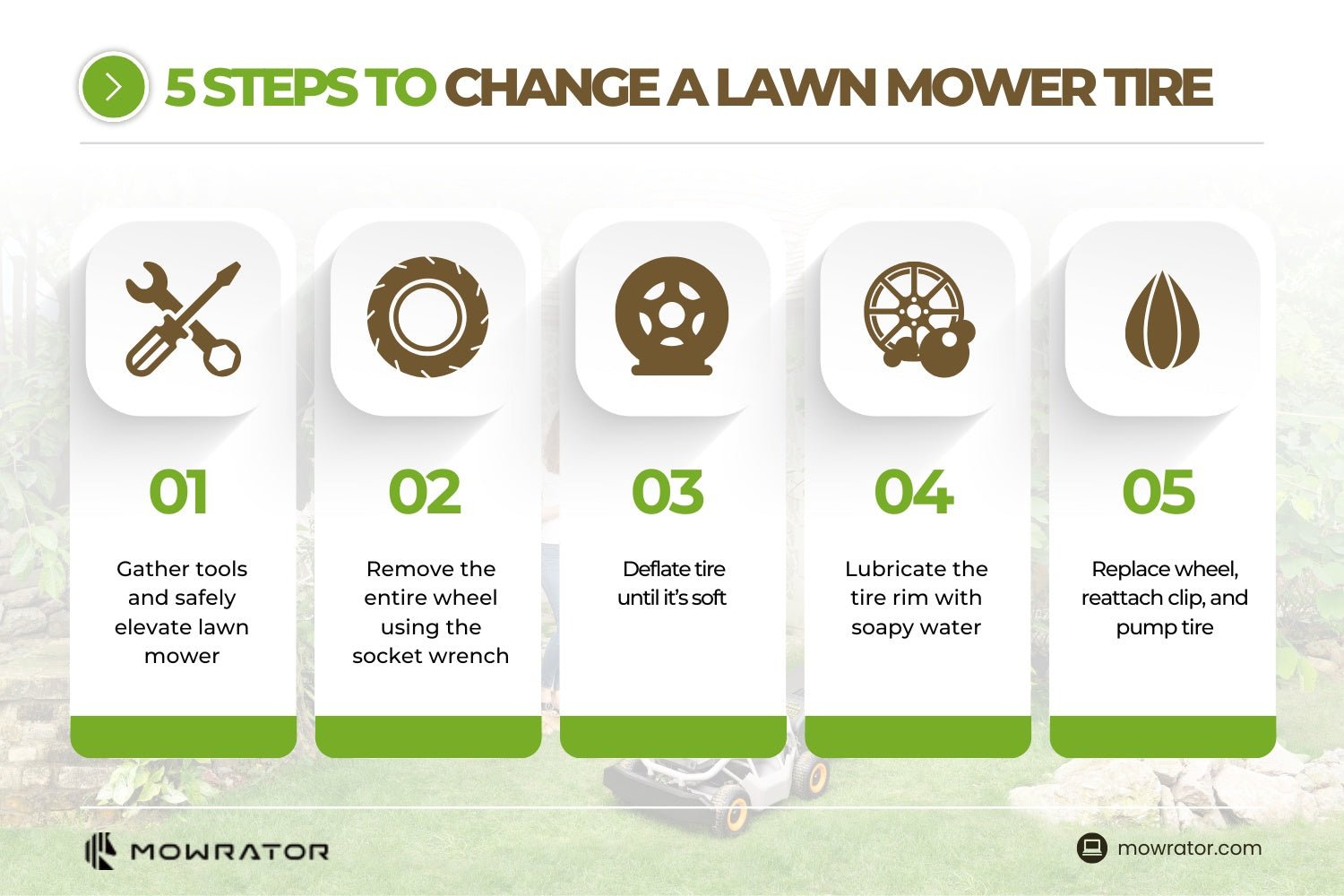
You do not need a full mechanic’s shop, but you do need the right basics. A simple tool set makes the job cleaner and much safer. Most tire changes take 30 to 60 minutes if the wheel is not seized.
Use these tools before you start:
- Socket set or wrench set
- Pliers for cotter pins or clips
- Flat screwdriver or tire irons
- Jack stands, wood blocks, or a mower lift point
- Soapy water in a spray bottle or bucket
- Air compressor or hand pump with gauge
- Rag and wire brush
Shut off the engine, remove the key, and disconnect the spark plug wire if your mower has one. That prevents an accidental start. If the mower is a riding model, park it on level ground and set the parking brake.
For safe lifting, support the mower solidly. A small front wheel can be lifted with blocks, but a rear tire on a riding mower often needs a jack and a stand. Never rely on the jack alone. A shifting mower can pinch fingers or drop fast when the wheel comes free.
If you want official safety guidance for small engines and outdoor equipment, the mower safety guidance from CPSC is a useful reference. It covers basic precautions that help prevent injuries during maintenance.
Remove the wheel without damaging the axle
Now you can take the wheel off. Start by looking for a center cap, cotter pin, snap ring, or retaining washer. Different mower brands use different hardware, so do not force the wheel until you know what is holding it in place.
If there is a cotter pin, straighten and pull it out with pliers. If there is a snap ring, pry it off carefully. Then slide the wheel off the axle. A stuck wheel is often caused by rust on the axle shaft or dried grass packed behind the hub.
Do not hammer hard on the axle. Too much force can bend the shaft or damage the transmission housing on a riding mower. If the wheel is stuck, spray a little penetrating oil at the hub and wait a few minutes. Then wiggle the wheel while pulling straight out.
As soon as the wheel is off, lay out the parts in order. Keep washers, spacers, and bushings in the exact sequence you removed them. This is one of the easiest ways to avoid a wheel that rubs, wobbles, or sits too far inward after reinstallation.

Credit: reddit.com
Separate the old tire from the rim
This step matters more than most people expect. The rim is usually what gets damaged during tire removal, not the tire itself. If you bend the bead area or scratch the rim deeply, the new tire may leak even when it is installed correctly.
First, fully deflate the tire if any air remains. If the tire has a valve stem core, remove it so all air escapes. Then break the bead, which is the tight seal between the tire and the rim. A bead breaker tool works best, but a pair of tire irons and steady pressure can also do the job on many mower tires.
Once one side of the tire is loose, work the edge over the rim slowly. Use a little soapy water on the bead to reduce friction. Move around the tire in small sections instead of trying to pry off one huge section at once.
For split rims or heavily rusted rims, take extra care. Some wheels are easier to replace as a full assembly than to repair in pieces. If the rim edge is badly rusted through, a new tire alone will not fix the problem.
Inspect the rim, valve stem, and bead seat
With the tire off, check the rim closely. Look for rust, dents, cracks, and sharp edges. A tiny metal burr can cut a new tire bead or damage a tube during inflation. Clean the rim with a wire brush or sandpaper until the bead seat is smooth.
Check the valve stem by bending it gently. If it feels dry, cracked, or loose, replace it now. A weak valve stem is a common cause of slow leaks, and it is much easier to change while the tire is off the wheel. On many mower tires, that small rubber part is the real problem, not the rubber tire itself.
If the rim has a tube inside, remove it carefully and inspect it for holes or pinches. A tube can fail if it was twisted during the last installation. That is a common hidden issue people miss when learning how to change a lawn mower tire.
Mount the new tire and seat the bead correctly
Before mounting, compare the new tire to the old one. The size, width, and direction of tread should match the mower’s use. Some mower tires are directional, which means the tread pattern is designed to roll in one direction for better traction.
Lubricate both tire beads with soapy water. This is enough for most lawn mower tires. You do not need grease, and heavy oil can make the tire slip or attract dirt. Put one bead over the rim first, then work the second bead into place with tire irons or your hands if the tire is small enough.
If the tire uses a tube, add a small amount of air to the tube first so it holds its shape. This reduces pinching during installation. Make sure the tube valve sits straight through the rim hole before you finish mounting the second bead.
After the tire is on, inflate it slowly. You should hear the bead pop into place on both sides. Stop and check that the bead is even all the way around. If one section is high or low, release air and reseat that area before continuing. Most lawn mower tires seat at low pressure, often between 10 and 20 PSI, but always follow the tire sidewall and mower manual if they specify a different number.
When a tire won’t seat
If the bead refuses to seal, the issue is usually one of three things: dirt on the rim, a twisted tube, or not enough lubrication. Clean the rim again, add fresh soapy water, and inflate in short bursts. A weak compressor can also slow the process, especially on larger rear tires.
Never overinflate a tire to force the bead into place. Too much pressure can damage the tire, the rim, or you. If the tire still will not seat after a careful attempt, stop and inspect for rim damage or a tire defect.
Reinstall the wheel and test the mower
Slide the wheel back onto the axle in the same order as the original parts. This is where your organized layout pays off. Replace washers, spacers, and clips exactly where they came from so the wheel stays centered and spins freely.
Tighten the retaining hardware securely, but do not crush the wheel hub. The wheel should spin without rubbing the frame. If it binds, something is in the wrong place. A misplaced spacer can create drag and uneven tire wear.
Once the wheel is on, lower the mower and check the tire again. Inflate it to the correct pressure if needed, then spin the wheel by hand. Listen for scraping or wobble. Move the mower a few feet and confirm that it rolls straight.
For a riding mower, do a short slow drive on flat ground. For a push mower, roll it over the yard edge or driveway to see how the tire tracks. If the mower pulls to one side, the wheel may not be fully seated or the axle hardware may be uneven.
Credit: mowrator.com
Common mistakes that cause leaks or poor performance
Most problems after a tire change come from simple installation errors. The good news is that these are easy to avoid once you know what to watch for.
- Using the wrong tire size causes sidewall stress and poor fit.
- Forgetting a spacer or washer makes the wheel wobble.
- Inflating too fast can pinch a tube or overseat the bead.
- Skipping rim cleaning leaves rust that causes slow leaks.
- Reusing a cracked valve stem creates another air loss point.
One non-obvious problem is tire age. A tire may still have tread left but be too old to trust. Small mower tires often dry out before the tread wears down. If you see fine cracks across the sidewall, replacement is the better choice even if the tread looks usable.
Another hidden issue is weight imbalance. Lawn mower tires are small, so even a slight rim dent or extra mud buildup can make the wheel feel uneven. If the mower vibrates more after a tire change, inspect the rim and hub before assuming the engine is the cause.
How to know whether to repair or replace the whole wheel
Sometimes the tire is not the real failure. If the rim is bent, badly rusted, or split at the bead, replacing only the tire may be wasted effort. In that case, a complete wheel assembly can be the cleaner fix.
Choose a tire-only replacement when the rim is straight, the valve stem is sound, and the hub hardware is reusable. Choose a full wheel replacement when you see deep rust, cracks, repeated air loss, or a wobble that does not go away after cleaning and reseating.
This choice saves time and prevents repeat repairs. A cheap tire on a damaged rim often fails again within weeks. A solid wheel assembly may be the better long-term repair even though it takes less time to install than rebuilding a bad rim.
If you are working on a specific mower model, the owner’s manual is worth checking before you buy parts. Manufacturer specs can confirm tire size, pressure range, and wheel hardware layout, which is especially useful on riding mowers with nonstandard axles.
Final checks for a safe, smooth ride
After the repair, take one last look at the tire pressure, bead seating, and wheel retention hardware. A mower tire should sit flat, spin straight, and hold air without a slow leak. Those three checks tell you the job was done correctly.
If you are learning how to change a lawn mower tire, the biggest payoff comes from careful prep, not force. Clean the rim, match the size, protect the valve stem, and keep the hardware in order. That approach prevents most problems before they start.
Once you have done it once, the process becomes much easier. The next time a tire goes flat, you will know exactly where to look first and how to get the mower back in service without guessing.
Credit: mowrator.com
FAQs
How long does it take to change a lawn mower tire?
Most tire changes take 30 to 60 minutes for a simple wheel. If the rim is rusty, the wheel is stuck, or the tire will not seat easily, it can take longer.
Can I change a lawn mower tire without special tools?
Yes, for many small mower wheels. A wrench, pliers, soapy water, and a way to lift the mower are often enough. Tire irons help, but they are not always required for small tires.
Should I replace the tube when I replace the tire?
If the tire uses a tube, replacing the tube is often a smart move, especially if the old tube is aged, patched, or hard to inspect. A fresh tube reduces the chance of another leak.
What tire pressure should a lawn mower tire have?
It depends on the tire and mower model, but many lawn mower tires use low pressure, often in the 10 to 20 PSI range. Always check the tire sidewall or owner’s manual before inflating.
Why does my new lawn mower tire keep going flat?
The most common causes are a bad valve stem, a dirty or rusty rim, a pinched tube, or a small puncture in the tire. Inspect those areas first before assuming the new tire is faulty.